
David committed adultery with Bathsheba, the wife of Uriah. When Bathsheba became pregnant, David killed Uriah to cover his illicit deeds. He then married Bathsheba, who gave birth to a son. That child died at a young age. In God’s mercy, David and Bathsheba had another son named Solomon. Solomon succeeded David and reigned for forty years.
Early in his reign, the Lord visited Solomon and said, “Ask what I shall give you.” What would you do with a blank check signed by God? 1 Kings 3:9 says Solomon requested “an understanding mind” to discern between goodand evil. Solomon’s request for wisdom pleased the Lord because he did not ask for longevity, fame, strength, wealth, or success. The Lord granted Solomon surpassing wisdom and threw in incomparable riches and honor.
Solomon is the wisest man who ever lived. His God-given wisdom is recorded in God-breathed scripture. Solomon wrote Psalms 72 and 127. He wrote most of Proverbs, the Song of Solomon, and Ecclesiastes. This body of work reflects different seasons of Solomon’s life.
- He wrote Song of Solomon as a young man in love with life ahead of him.
- He wrote Proverbs as a middle-aged man teaching his children wisdom.
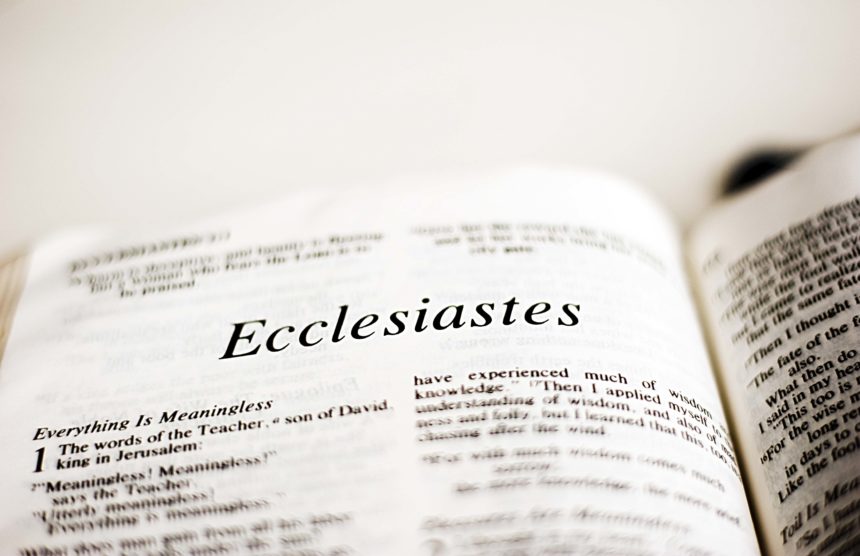
- He wrote Ecclesiastes as an old and weary man reflecting on a wasted life.
Ecclesiastes is the sad sequel to Proverbs. Proverbs teaches principles to practice for a long, wise, and blessed life. In Ecclesiastes, Solomon looks back with regret that he did not take his own advice. It is the autobiography of a wise man who played the fool.
When I shared my plan to preach Ecclesiastes with pastor friends, some cynically asked, “Why?” Others advised me to only preach selected passages. Few encouraged me to preach through Ecclesiastes. If pastors think or feelthis way, no wonder most Christians avoid Ecclesiastes. I’ll take the pulpit liberty to say none of your favorite Bible passages are in Ecclesiastes. Admittedly, Ecclesiastes is a difficult book. It contains great treasures. But those treasures do not sit on the surface of the text. You must dig deep for them. If you encouraged someone to read the Bible, what book would you recommend?
- What would you recommend a young person to read to shape their values?
- What would you recommend a person to read to avoid a midlife crisis?
- What would you recommend a godly person who wants to walk right to read?
- What would you recommend a person who is deconstructing their faith to read?
- What would you recommend a person who has strayed away from God to read?
Many Bible books may come to your mind. Is Ecclesiastes on that list? If not, it should be. Ecclesiastes is the most contemporary book in the Bible. It is as old as Solomon and as current as today’s newspaper. Herman Melville called it “the truest of all books.” This ancient book has a relevant message: Life without God is meaningless. Why study Ecclesiastes? Ecclesiastes 1:1-3 presents three reasons to read and reflect on the message of Ecclesiastes.
The Double Author
Imagine the wisest philosopher, wealthiest mogul, shrewdest politician, highest-regarded executive, and most-followed social media influencer co-wrote a book. Would you read it? That book is Ecclesiastes. All of these noteworthy contributors are represented in one man, who published this masterwork for free. Consider the double author of Ecclesiastes.
The Human Author. Solomon wrote Ecclesiastes, even though he does not identify himself by name. Some Bible scholars question Solomon’s authorship of Ecclesiastes. But the superscription in Ecclesiastes 1:1 reveals Solomon as the author definitively, though discreetly.
Solomon the Preacher. “Preacher” translates the Hebrew term Qoheleth. It refers to one who collects or gathers – “one who leads an assembly.” In the Greek New Testament, the word for church is ekklesia. It means “an assembly.” The Septuagint translates the Hebrew Qoheleth with the Greek “Ecclesiastes.” It is the title of the book. It is also the author of the book.
- The ESV translates Qoheleth “the Preacher.”
- The NIV translates Qoheleth “the Teacher.”
Ecclesiastes is a sermon. Solomon is the preacher who teaches the assembly of God’s people about life, death, and eternity.
Solomon the King. This preacher was not just a preacher. He was “the son of David, king in Jerusalem.” David was the giant-slayer, the sweet singer of Israel, the man after God’s own heart. He had many sons. “Son of David” refers to his royal bloodline – the one who succeeded him. “Son of David” is ultimately a messianic title that points to the Lord Jesus Christ. That this reference points to Solomon is evidenced by the fact that this “son of David” was “king in Jerusalem.” Ecclesiastes 1:12 says, “I the Preacher have been king over Israel in Jerusalem.”
According to Ecclesiastes 12:12, Solomon wrote this book to or for his son. The king warns his prince not to make his mistakes. This wise fool also writes Ecclesiastes to the assembly of God’s people and to all who would know and live the truth.
The Divine Author. Ecclesiastes is not just the wisdom of Solomon. It is divine revelation from God to us. 2 Timothy 3:16 says, “All Scripture is breathed out by God and profitable for teaching, for reproof, for correction, for training in righteousness.” To read Ecclesiastes profitably requires belief in the inspiration, inerrancy, and infallibility of scripture. You must believe the Bible is God’s word.
Ray Stedman wrote, “The book of Ecclesiastes is unique in Scripture. No other book is like it because it is the only book in the Bible that reflects a human, rather than a divine, point of view.” Let me put that another way. Ecclesiastes records error, but it does not teach error. There are statements about life, death, and eternity in this book that are not true. These erroneous statements reflect Solomon’s folly when he sought meaning in life without God. Yet atheists and agnostics seize upon these statements to bolster their false truth-claims. Cults use proof-texts from this book to twist the truth to their spiritual, theological, and eternal harm.
Harold Kushner called Ecclesiastes “the most dangerous book in the Bible.” There is a divine message in this dangerous book. Ecclesiastes 12:9-11 says, “Besides being wise, the Preacher also taught the people knowledge, weighing and studying and arranging many proverbs with great care. The Preacher sought to find words of delight, and uprightly he wrote words of truth. The words of the wise are like goads, and like nails firmly fixed are the collected sayings; they are given by one Shepherd.” Ecclesiastes is not a book of gloom and doom. These are “words of delight.” It is not the reflections of a bitter man. These words are given by “one Shepherd” to lead in paths of righteousness.
Ecclesiastes 12:13-14 concludes: “The end of the matter; all has been heard. Fear God and keep his commandments, for this is the whole duty of man. For God will bring every deed into judgment, with every secret thing, whether good or evil.”
The Timeless Message
Ecclesiastes 1:2 records the theme of the book: “Vanity of vanities, says the Preacher, Vanity of vanities! All is vanity.” This is the motto of Ecclesiastes. It is stated here at the beginning of the book. It is repeated at the end of the book. Ecclesiastes 12:8 says, “Vanity of vanities, says the Preacher; all is vanity.” These bookends emphatically declare the main idea of Ecclesiastes – an ultimate and absolute claim about life.
An Ultimate Claim. “Vanity” is the keyword of Ecclesiastes, occurring thirty-eight times in the book. Derek Kidner called it “a desperate word.” We use the term for pride of face. The person fixated on their appearance, who can’t stop looking in the mirror, constantly snapping selfies, is vain. That is not what Solomon means. “Vanity” translates hevel. It means a breath or vapor.
- Like a breath, life is empty.
- Like a vapor, life is elusive.
In Genesis 4:2, Adam and Eve named their second son “Abel.” We don’t know why they named him this Hebrew word for “breath” or “vapor.” We do know that Abel was killed by his brother six verses later! That is a powerful illustration of what hevel conveys. It is that which is without substance or that which soon disappears. “Vanity of vanities” is superlative language.
- The “Holy of holies” is the most holy place.
- The “King of kings” is the greatest king.
- The “Heaven of heavens” is the highest heaven.
“Vanity of vanities” is ultimate futility, perfect meaninglessness, complete absurdity. This is the Preacher’s view of life: “Vanity of vanities!” He does not explain what this phrase means in verse 2. He will flesh it out throughout the book. For now, he simply repeats the phrase for emphasis. Throughout Ecclesiastes, Solomon will use another phrase to define and describe vanity: “striving after wind.” Life without God is meaningless.
An Absolute Claim. Solomon does not merely claim that some things or bad things or false things are vanity. Verse 2 says, “All is vanity.” The whole is vanity. James 4:14 says, “What is your life? For you are a mist that appears for a little time and then vanishes.” Life in its totality is insubstantial and transitory. Let me be clear. Solomon was no pessimist.
- An optimist sees an opportunity in every difficulty.
- But a pessimist sees a difficulty in every opportunity.
It has been said that a pessimist cannot wait for the future so he can look back with regret. That was not Solomon’s perspective or philosophy. If anything, Solomon was a realist. He understood what it meant to live in a fallen world. Romans 8:20 says, “The creation was subjected to futility.” Sin separates man from God and renders life unsatisfying. Everyone seeks satisfaction – from the youngest of babies to the oldest of men. It’s true of the person on the other side of the pew and the person on the other side of the world. Everyone wants to find satisfaction. Yet true satisfaction in life remains an elusive commodity, no matter the many and various promises of satisfaction guaranteed.
If anyone had the time, skill, knowledge, power, and resources to find satisfaction, it was Solomon. Yet F.B. Meyer rightly calls Ecclesiastes “The Testimony of an Unsatisfied Soul.” He found no satisfaction in wisdom, work, wealth, wine, or women. Why? Life without God is meaningless.
The Probing Question
In Greek Mythology, the craftiness, deceit, and treachery of Sisyphus invoked the wrath of Zeus. Hades punished Sisyphus by forcing him to spend eternity pushing a heavy boulder up a steep hill. When he neared the top of the hill, the boulder rolled away, causing Sisyphus to start again.
Ecclesiastes asserts that life without God is a vicious cycle that is infinitely worse than the myth of Sisyphus. Verse 3 asks, “What does a man gain by all the toil at which he toils under the sun?” Ecclesiastes has been called “a book about labor.” The rhetorical question in verse 3 states the problem and perspective of Ecclesiastes.
The Problem of Ecclesiastes. Verse 3 holds two terms in tension to address the problem Ecclesiastes addresses.
Toil. “Toil” is hard work. It may refer to the process or result of one’s labor. The process of toil is strenuous. The result of toil is exhaustion. This is an apt description of life in a fallen world. In Genesis 3:19, “By the sweat of your face you shall eat bread, till you return to the ground, for out of it you were taken; for you are dust, and to dust you shall return.” This was not just Adam’s dilemma. It is true of everyone who is born of a woman. Psalm 90:10 says, “The years of our lives are seventy, or even by reason of strength eighty; yet their span is but toil and trouble; they are soon gone, and we fly away.”Only Jesus offers true rest from life’s toil. Matthew 11:28 says, “Come to me, all who labor and are heavy laden, and I will give you rest.”
Gain. “Gain” is a commercial term. It means “something leftover.” It’s the reward, payoff, dividend, surplus, or return on investment.
- What does one gain from all his toil?
- Will my hard work show a net profit?
- Is my life really worth living after all?
The answer to his question is not absolute. Ecclesiastes 2:13 says, “There is more gain in wisdom than in folly, as there is more gain in light than in darkness.” Yet none of this is of any benefit without God. Psalm 127:1 says, “Unless the Lord builds the house, those who build it labor in vain. Unless the Lord watches over the city, the watchman stays awake in vain. It is in vain that you rise up early and go late to rest, eating the bread of anxious toil; for he gives to his beloved sleep.” How do you sleep at night? Without the Lord, you will spend your days and nights eating the bread of anxious toil without true or lasting satisfaction. Matthew 16:26 asks, “For what will it profit a man if he gains the whole world and forfeits his soul? Or what shall a man give in return for his soul?”
The Perspective of Ecclesiastes. Verse 3 asks, “What does man gain by all the toil at which he toils under the sun?” “Under the sun” is a key phrase in Ecclesiastes. Solomon uses it twenty-nine times in the book. It is the perspective through which Ecclesiastes sees life. “Under the sun” is not a secular view of life in contrast to a spiritual view of life. It is the sphere and scope of the human experience in a fallen world that is in rebellion against its Creator.
Many years ago, I flew home to Los Angeles after a preaching engagement. As we approached LAX, I looked out the window at the lights of the city and thought, “What a beautiful city!” Then, on the ride home from the airport, I saw the damage from the Rodney King riots and thought, “This is terrible.” It was the same city. What changed was my perspective.
There are two ways to view life.
- There is vanity under the sun.
- There is victory in the Son.
We are not wiser than Solomon. However, through progressive revelation, we get the rest of the story that Solomon did not know. God sent his only begotten Son into the world. Jesus was born of a virgin. He lived a righteous life. He died on the cross for our sins. He was buried in Joseph’s new tomb. On the third day, he rose from the dead. He ascended to glory and is seated at the Father’s right hand. And he will soon return to judge the wicked, reward the righteous, and consummate the kingdom. 1 Corinthians 15:19 says, “If in Christ we have hope in this life only, we are of all people most to be pitied.” That’s not our story. Jesus lives! 1 Corinthians 15:58 says, “Therefore, my beloved brothers, be steadfast, immovable, always abounding in the work of the Lord, knowing that in the Lord your labor is not in vain.”