
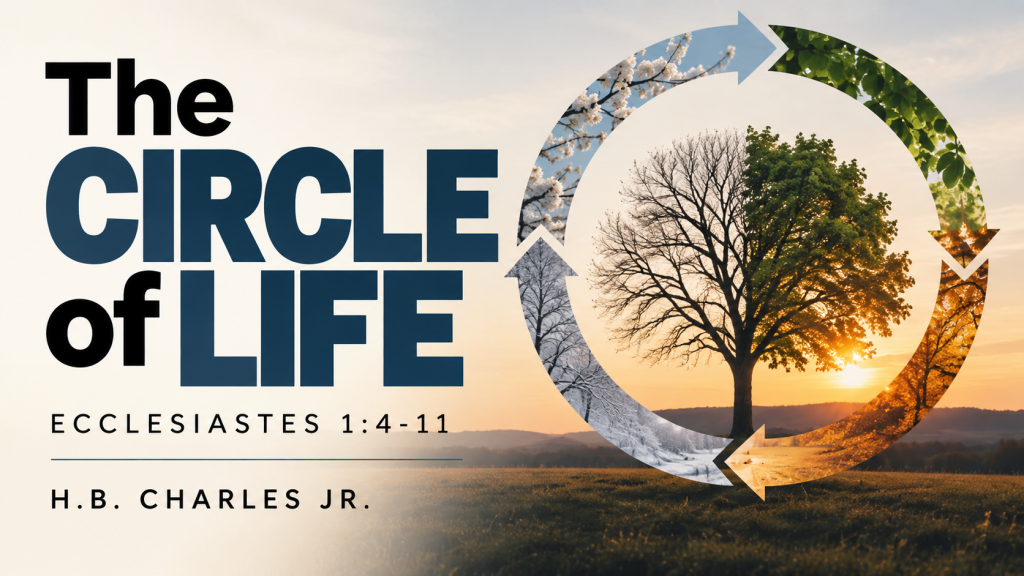
A young man graduated from college. His family threw a party to celebrate his accomplishment. His father asked him aside, “Now what?” “I am going to start my career,” he answered. “Then what?” “I will climb the corporate ladder to success.” “Then what?” “I will make a fortune and invest it wisely.” “Then what?” “I will marry the girl of my dreams and raise a family.” “Then what?” “I’ll retire and enjoy the good life.” “Then what?” “I guess I will grow old and die.” Once more, his father asked, “Then what?”
This father-son exchange reflects the probing question in Ecclesiastes 1:3: “What does man gain by all the toil at which he toils under the sun?”
This is not a passing concern. The Preacher repeatedly addresses this dilemma. Ecclesiastes 2:22 asks, “What has a man from all the toil and strive of heart with which he toils beneath the sun?”Ecclesiastes 3:9 asks, “What gain has the worker from his toil?” Ecclesiastes 5:15-16 says, “As he came from his mother’s womb he shall go again, same as he came, and shall take nothing for his toil that he may carry away in his hand. This also is a grievous evil: just as he came, so shall he go, and what gain is there to him who toils for the wind?”
Life is filled with great toil, hard work, and tiring labor. This is not just a statement about one’s vocation. Youth, education, health, family, and goals all involve toil.
- What do we gain?
- What difference does it make?
- What’s the meaning of it all?
That’s the question that consumes Solomon in Ecclesiastes. Verses 4-11 follow that probing question with a poem. The poem is not a direct answer. You must follow the argument of Ecclesiastes to its conclusion for the answer. Yet the poem does not avoid the question. It compels us to think about the matter and draw our own conclusions.
The Disney classic, The Lion King, begins with an Elton John song called “The Circle of Life.” The number begins the movie on a triumphant note to which it will return in its climax. That’s not the tone of this opening song in Ecclesiastes. It feels more frustrating than hopeful. Yet Solomon does not speak as a prophet of doom declaring the end of the world. He speaks like a doctor diagnosing the sickness so you may consider treatment options.
The point of the poem is this: Life is a vicious circle you cannot escape on your own. This monotonous treadmill can be escaped. But you cannot do it on your own. Duane Garrett said, “This passage is not a contradiction to the gospel but a call for it.” What is the circle of life? Ecclesiastes 1:4-11 gives two irrefutable proofs of the circle of life.
Nature Proves the Circle of Life.
Nature teaches us many truths about God. It is called general revelation. Nature also teaches us many truths about us. Verses 4-7 teach us big life lessons from nature.
The Permanence of the World Around Us. Verse 4 states a contrast: “A generation goes, and a generation comes, but the earth remains forever.”
The Passing Generations. Solomon says, “A generation goes, and a generation comes.” “Generation” may refer to time or people. The reference here is about humanity. People are born and grow and live and age and die. It has been said that we are born in hospitals and die in hospitals and spend our lives trying to stay out of the hospital. During our lives, we reproduce, only to have our children replace us as we check out of here. A generation comes and goes.
The Abiding Creation. Solomon says, “The earth remains forever.” He does not mean the present created order is eternal. Heaven and earth will pass away. It will be replaced by a new heaven and a new earth. The point here is in the contrast. We are made of dust and will return to it. Yet the earth remains forever. The earth was made for man to enjoy and exercise dominion over it. Yet is abides to witness the going and coming of generations of men.
The Pattern of the World Around Us. The earth remains forever. Yet it is not exempt from the circle of life. Verses 5-7 record three illustrations of nature’s life cycle.
The Rising Sun. Verse 5 says, “The sun rises, and the sun goes down, and hastens to the place where it rises.” We know the earth orbits around the sun. Yet meteorologists still speak of sunrise and sunset. Here Solomon points to the sun rising in the east and setting in the west. As we sleep, it is as if the sun pantingly laps around the earth to start its race again at dawn. This daily orbit is so constant that the news can predict when the sun will rise and set by the minute.
The Blowing Wind. This picture of nature’s patterns encompasses all four directions.
- Verse 5 describes the east-west shining of the sun.
- Verse 6 describes the south-north blowing of the wind.
Verse 6 says, “The wind blows to the south and goes around to the north; around and around goes the wind, and on its circuit the wind returns.” The wind seems to blow randomly, chaotically, and extemporaneously. Yet the wind actually blows according to a well-defined circuit that can be charted and predicted.
The Flowing Stream. Verse 7 says, “All streams run to the sea, but the sea is not full; to the place where the stream flows, there they flow again.” The Dead Sea illustrates this phenomenon. The Jordan Riverflows into the Dead Sea. Because it is the lowest land-based elevation on Earth, the Dead Sea has not outflow. Yet it does not overflow as the Jordan pours into it. Streams perpetually flow into the sea without ever filling, much less overflowing the sea.
Life is a vicious circle that we cannot escape on our own. Solomon proves this by pointing to the natural elements of earth, sun, wind, and water. But the world is not a closed universe that operates independently. Genesis 1:1 says, “In the beginning, God created the heavens and the earth.” Creationism argues for more than intelligent design. It argues for divine sovereignty. The one who creates a thing is greater than the thing he creates and rules over it. There is one who is not subject to nature’s unrelenting treadmill.
- He is the one who parted the Red Sea for Moses.
- He is the one who cause the sun to stand still for Joshua.
- He is the one who stopped and sent the rain for Elisha.
- He is the one who reversed Ahaz’s sundial for Hezekiah.
- He is the one who raised Jesus from the dead on the third day.
He is the only one who can save you from the vicious circle of life!
History Proves the Circle of Life.
- Verses 4-7 describe how nature works.
- Verses 8-11 describe how history works.
It is often said that what we learn from history is that we do not learn from history. That lesson is important to learn if we learn nothing else from history. Verses 8-11 make three points about the ongoing story of human experience.
Nothing Is Satisfying. Verse 8 is the response to the realities described in verses 4-7: “All things are full of weariness; a man cannot utter it; the eye is not satisfied with seeing, nor the era filled hearing. “Wearisome” may refer to cause or effect. Here, it refers to the effects the circle of life has on us. It is wearisome, tiresome, burdensome.
- Life is not a wheel of fortune.
- Life is a wheel of futility.
“A man cannot utter it” expresses the fact that the circle of life is so exhausting that our minds cannot fully comprehend it and our mouths cannot fully communicate it. Verse 8 mentions two senses to make his point.
The Unsatisfied Eye. Verse 8 says, “The eye is not satisfied with seeing.” The social media influencer who humble-brags about the exotic locations they visit is always looking for the next vacation spot to travel to. They do not say, “I’ve seen enough.” For that matter, social media users can spend hours doomscrolling and quit only because they must get some sleep before work or school in the morning, not because they have seen enough.
The Unfulfilled Ear. Claims of information overload are most often hypocritical.
- The one who says, “I’ve seen enough!” does not usually mean it.
- The one who says, “I’ve heard it all!” does not usually mean it.
The world is filled with talk, gossip, news, rants, speeches, alerts, music, and all kinds of other noise. Yet the ear is never full. Our eyes and ears are never satisfied. Warren Wiersbe wrote: “The eye cannot be satisfied until it sees the hand of God, and the ear cannot be satisfied until it hears the voice of God.”
Nothing is Original. Verses 9-10 record a disturbing announcement and a defiant assertion.
A Disturbing Announcement. Verse 9 says, “What has been is what will be, and what has been done is what will be done, and there is nothing new under the sun.” Solomon claims the past, present, and future coexist in such a way that nothing really changes. William Barrack wrote: “The past is the future; the future is the past.”
Verse 9 ends with the most famous statement in Ecclesiastes: “There is nothing new under the sun.” Man is constantly searching for something new or novel. It does not exist. The quest for something new is the equivalent of a blind man looking for a black cat in the dark room that is not actually there. There is nothing new under the sun. “Under the sun” is the key phrase in this statement. This phrase occurs twenty-nine times in Ecclesiastes. It is the second time the phrase is used in this chapter. Verse 3 asks, “What does man gain by all the toil at which he toils under the sun?” “Under the sun” is the sphere and scope of human experience. It is life as sinful people in a fallen world.
- We think we gain by toppling those over us.
- We think we gain by outdoing those around us.
- We think we gain by surpassing those before us.
Life ends up being the same old, same old. The more things change, the more they stay the same. Robert Davidson wrote, “Sometimes we feel like pioneers exploring virgin territory only to discover the footprints of those who have travelled this way before us.”
A Defiant Assertion. Verse 10 is the first objection to the big and bold statements Solomon makes in Ecclesiastes. Anticipating disagreement, Solomon asks, “Is there a thing of which it is said, ‘See, this is new’?” Virtually any person living in the contemporary world feels confident enough to take on Solomon at this point. We have new medical treatments, scientific advances, modes of travel, technological devices, means of communication, space explorations, and weapons of war. Yet verse 10 insists: “It has been already in the ages before us.” Our “new” things were created from old stuff that already existed. We enjoy things to make life more convenient and comfortable that Solomon could never have dreamed of. None of them change the inevitable consequences of being sinful people in a fallen world. Life remains brief, fragile, painful, wearisome, and vain.
Solomon is wrong – not in the way that you think he is. There is something new under the sun! Klass Schilder wrote: “Christ came into the world, that he might break the cycle of the vicious circle.”
- Christ’s blood established a new covenant.
- Christ’s atoning death provides new life.
- Christ’s resurrection grants a new name.
- Christ’s grace adopts into a new family.
- Christ’s redemption provides a new destiny.
As a man sat at his table drinking coffee and reading the paper, he found his name in the obituary section. He called the newspaper, demanded to speak to the editor, and insisted that he was not dead. The editor apologized. But that was not enough for the man. He argued that something had to be done to rectify the situation. The editor said he would put the man’s name in the birth section of the next morning’s paper so that he could start all over again.
No, you cannot start life all over again and have a new beginning. But if you run to the cross, you can have a new ending. 2 Corinthians 5:17 says, “Therefore, if anyone is in Christ, he is a new creation. The old has passed away; behold, the new has come.”
Nothing is Remembered. Verse 11 says, “There is no remembrance of former things, nor will there be any remembrance of later things yet to be among those who come after.” “Remembrance” is to call to mind and act accordingly. It is the means and mark of devotion to God. In the Passover, God calls Israel to remember their exodus from Egypt. In the Lord’s Supper, Christians are called to remember the body and blood of Christ. There are things worth remembering. Yet as sinful people in a fallen world, we forget what we should remember and remember what we should forget. This is all a part of the circle of life.
- There is no remembrance of former things.
- There will be no remembrance of later things yet to be.
Human ambition strives to say, do, or make something that will leave a legacy. We desire to accomplish something that will be remembered for generations to come. But the reality is that we live and die and are forgotten.
- Best-selling books eventually go out of print.
- World leaders become a footnote in history.
- Famous people become trivial pursuit questions.
- A new Super Bowl champion is crowned every year.
- Longstanding empires become lost civilizations.
Solomon is right. Nothing is remembered. Yet Solomon is wrong! Let me call an expert witness to refute Solomon’s case. My witness was not as wise as Solomon. He was a foolish man who wasted his life robbing and stealing. The law caught up with him. He was condemned to death. On the day of his execution, he happened to be crucified next to a carpenter-turned-rabbi from Nazareth. After hanging next to Jesus for several hours, he determined that Jesus was wrongly condemned. In his dying breath, he said, “Lord, when you come into your kingdom, remember me.” Luke 23:43 responds, “Today, you will be with me in paradise.”
The dying thief rejoiced to see
That fountain in his day
And there may I, though vile as he
Wash all my sins away.