
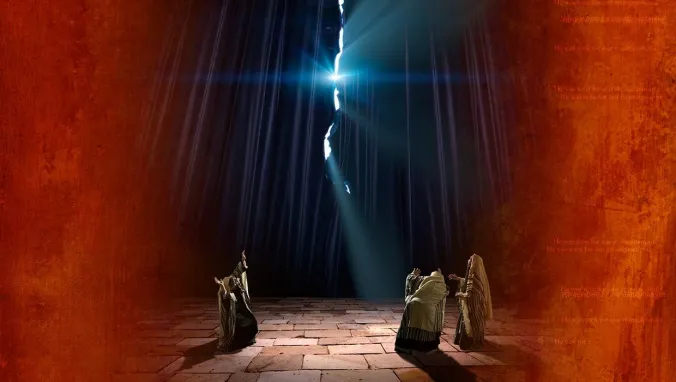
The Lord commanded Moses to erect a tabernacle – a tent of meeting that signified God’s presence with Israel during their wilderness wanderings. It was to be built according to the Lord’s exacting specifications. David desired to build a house for God. Solomon – David’s son and successor – built the temple in Jerusalem. The temple complex had three courts.
- The outer court of the temple was the vestibule that was open to the public.
- The Holy Place was the inner court where the priests performed their ministry.
- The Most Holy Place is where the Lord’s glorious presence symbolically resided.
A curtain separated the outer court from the Holy Place. Another curtain separated the Holy Place from the Holy of Holies. These curtains were not the drapes that cover your windows at home. This curtain of the temple was stronger and sturdier than the walls of a house. It was sixty feet wide and thirty feet high. Made of blue, purple, and scarlet, the curtain was as thick as the span of a man’s hand – between six and ten inches. Jewish tradition claims it was so heavy that it took three hundred men to lift it and put it in place.
Only the high priest could go through this curtain of the temple. He could only pass through the veil on the Day of Atonement – with the smoke of incense and the blood of sacrifice – to atone for the sins of the nation. He shared his location by wearing bells on his liturgical garments. It is said that the people tied a robe around his waist to pull him out if he died in the presence of God. No one dared breach the Most Holy Place any other time. The cherubin woven into the curtain all but announced, “Keep Out!”
On the day Jesus died on the cross, something happened. Matthew 27:51 says, “And behold, the curtain of the temple was torn in two, from top to bottom.” This stunning truth-claim is no tabloid report of fake news. It is also reported in Mark 15:38 and Luke 23:45. No Jewish historian records the tearing of the curtain of the temple. Neither do any ancient sources refute this claim of the early church.
The Synoptic Gospels writers tell us that it happened. They do not explain the meaning of this strange occurrence. What are we to do with this torn curtain? Matthew 27:51 records this detail with a vivid introduction: “And behold.” “Behold” is a word of wonder that conveys surprise. “Behold” is also a call to attention. “See!” “Look!” “Watch!”Matthew used a God-breathed “highlighter” to emphasize the miracle, moment, mystery, message, and magnitude of the torn curtain. The cross of Jesus opens a new and living way to God. Leon Morris said, “Religion has never been the same now that Jesus the Messiah had died for sinners.” What happened when the curtain was torn? Let’s answer that question from three perspectives.
How The Curtain Was Torn
Matthew 27:51 uses a passive verb to describe this cosmic event: “the curtain of the temple was torn.” Scholars call this the passivum divinum – the divine passive. The language suggests it just happened without an actor or agent involved. The discerning reader knows the Jehovistic hand of God was at work behind the scenes. Saul threw his javelin to kill David. David barely escaped with his life. My dad said when David got to safety, he said to the Lord, “You’re fast, but not that fast. I know it was you who pushed me out of the way.” God is not mentioned in our text. We know that God did it by how God did it.
The curtain was torn in two. The curtain of the temple did not fall apart in tatters accidentally or incidentally. It was intentionally torn in one singular act. The curtain was not partially slit, ripped, or cracked. This was no minor tear. It was torn in two. This bisected tear completely destroyed the curtain. Curtain was more than a label for the item. It was a technical term for its purpose and function. The curtain had a twofold function: To keep something in and to keep something out. Being torn in two, it could no longer serve that function.
When I was a boy, I played hard at recess. On multiple occasions, I came home with holes in the knees of my jeans. My mother did not throw those jeans away. She sewed and ironed a patch over the hole for me to keep wearing them. The curtain of the temple was torn in two. No sewing, patching, or mending could fix it. Matthew 19:6 says, “What therefore God has joined together, let not man separate.” The inverse or reverse is also true. What God has separated, let not man join together.
The curtain was torn from top to bottom. If the curtain had split from the bottom and the tear worked its way up like a ragged sweater, it could have been written off as a mere coincidence. The curtain was torn in two from top to bottom. If a human culprit had done this, he would have had to sneak a sixty-foot ladder into the Holy of Holies. He would have had to get his hands around this thick curtain that was the span of a man’s hand. And with Samson-like strength, he would have had to tear the curtain in two from top to bottom without falling to his death. Impossible!
- Three hundred men lifted up the curtain and put it in place.
- A thousand men could not tear it in two from top to bottom.
No human, angelic, or demonic power pulled this off. It was a supernatural act of God. William R. Nicholson wrote, “It was not jerked apart by some intruder from below, but cleanly cut by an invisible hand from above.” God did it! Matthew 27:51-52 also reports: “And the earth shook, and the rocks were split. The tombs also were opened. And many bodies of the saints who had fallen asleep were raised.” The God who shook the earth, split the rocks, and opened the tombs, tore the curtain of the temple in two from top to bottom.
When The Curtain Was Torn
Some associate the tearing of the curtain with the earthquake at the end of the verse. It is a failed attempt to offer a logical explanation for the torn curtain. A seismic event left the temple complex unaffected. But the violent shaking tore the curtain of the temple from top to bottom. That is a logical fallacy that proves too much.
- The curtain did not tear because of a geological event that followed it.
- The curtain was torn because of a redemptive act that preceded it.
Matthew 27:50 says, “And Jesus cried out again with a loud voice and yielded up his spirit.” Then Matthew 27:51 ties what happened at Golgotha outside of the city to what happened in the temple in Jerusalem: “And behold, the curtain of the temple was torn in two, from top to bottom.” Charles Spurgeon said, “As if shocked at the sacrilegious murder of her Lord, the temple rent her garments, like one stricken with horror at some stupendous crime.” The miracle of the torn curtain can only be explained by the death of Jesus on the cross.
Jesus died submissively. Our text is a part of Matthew’s report of the death of Christ. Yet Matthew does not actually say that Jesus died on the cross. Verse 50 says, “And Jesus cried out again with a loud voice and yielded up his spirit.” Crucified men ultimately died of suffocation. They may have cussed and fussed vociferously. But the longer they hung on the cross, the more it sapped their strength. By the time death came, the victim was too weak to speak. Jesus “cried out again with a loud voice.” Our Savior did not die on the cross as a victim of execution. He “yielded up his spirit” willingly, volitionally, submissively.
John 10:17-18 says, “For this reason the Father loves me, because I lay down my life that I may take it up again. No one takes it from me, but I lay it down of my own accord. I have authority to lay it down, and I have authority to take it up again. This charge I have received from my Father.”
Jesus died sacrificially. Matthew 27:50 tells us that Jesus cried out again. When and what did he cry out before? Matthew 27:46 says, “And about the ninth hour Jesus cried out with a loud voice, saying, ‘Eli, Eli, lema sabachthani?’ that is, ‘My God, my God, why have you forsaken me?’”
This cry of dereliction reveals the power and purpose of the cross.
- He did not die as a political nuisance to the Romans.
- He did not die as a religious nonconformist to the Jews.
- He did not die as a failed revolutionary, getting his due.
Jesus died to make substitutionary atonement for our sins. When Karl Barth was asked what the most important word in the bible is, he answered “huper” – the Greek pronoun that means “on behalf of” or “in the place of.” He meant that the most important truth of the Bible is that Jesus died on the cross for us. Isaiah 53:4-6 says, “Surely he has borne our griefs and carried our sorrows; yet we esteemed him stricken, smitten by God, and afflicted. But he was pierced for our transgressions; he was crushed for our iniquities; upon him was the chastisement that brought us peace, and with his wounds we are healed. All we like sheep have gone astray; we have turned – every one – to his own way; and the Lord has laid on him the iniquity of us all.”
Jesus died supernaturally. Jesus was a man who lived in history and died a physical death on the cross.
- This man was not just any man.
- His death was not just any death.
The birth of Jesus was supernatural. He who in Eden’s garden took from a man a motherless woman, in Bethlehem’s barn took from a woman a fatherless man. Jesus was conceived by the Holy Spirit and born of a virgin. He was as old as his heavenly Father and ages older than his earthly mother. Jesus was born and died supernaturally. Miracles occurred to mark his incarnation. More miracles occurred to mark his crucifixion.
Note the repeated conjunctions Matthew uses to present the physical death of Jesus as a supernatural act of God. Matthew 27:50-53 says, “And Jesus cried out again with a loud voice and yielded up his spirit. And behold, the curtain of the temple was torn in two, from top to bottom. And the earth shook, and the rocks were split. The tombs also were opened. And many bodies of the saints who had fallen asleep were raised, and coming out of the tombs after his resurrection they went into the holy city and appeared to many.” We call it Good Friday because Calvary was a miracle!
Why The Curtain Was Torn
There are actors we associate with their superhero roles. We are fans of their movies, not just because of their acting skills. Special effects play a crucial role in the storytelling. A similar dynamic is at work in our inspired text. God uses divine GCI to make the story of the Passion of Christ come alive for us. The torn curtain illustrates two theological truths.
The Temple Was Closed. During a trip to Israel, I asked why priests no longer offer sacrifices on the altar. He answered because there is no temple. The Old Testament commands those acts of worship to be offered in the sanctuary. The Temple Institute in Jerusalem prepares for the day when a third temple will be built. In Judaism, the temple is the only true meeting place between God and man.
This is a critical element of Middle East conflicts. The hostility between Jews and Muslims is not just political, geographic, or economic. It is theological. Both claim the Temple Mount as the place to meet with God. Christians don’t get caught up in that dispute because we know that the temple has been closed. I’m not talking about the destruction of the temple in Jerusalem in A.D. 70. It was permanently closed when the curtain of the temple was torn in two from top to bottom when Jesus died. D.A. Carson said, “Jesus himself is the new temple, the meeting place of God and man; the old is obsolete.”
- We do not need human mediators.
- We do not need animal sacrifices.
- We do not need Mary’s intercession.
- We do not need religious relics.
- We do not need guardian angels.
- We do not need patron saints.
- We do not need tribal ancestors.
Hebrews 6:19-20 says, “We have this as a sure and steadfast anchor of the soul, a hope that enters into the inner place behind the curtain, where Jesus has gone as a forerunner on our behalf, having become a high priest forerunner after the order of Melchizedek.”
The Barrier Was Removed. “General Secretary Gorbachev, if you seek peace, if you seek prosperity for the Soviet Union and Eastern Europe, if you seek liberalization: Come here to this gate! Mr. Gorbachev, open this gate! Mr. Gorbachev, tear down this wall.” Those famous words were spoken on June 12, 1987, by former President Ronald Reagan during a speech at the Berlin Wall. The Berlin Wall was the “Iron Curtain” that separated Eastern communism from Western democracy. The fall of that wall on November 9, 1989, is considered one of the greatest liberating events of world history. But it pales in comparison to what happened when Jesus died on the cross for our sins. The curtain of the temple was torn in two from top to bottom. This supernatural visual aid is our all-access pass to God in Christ.
Hebrews 10:19-20 says, “Therefore, brothers, since we have confidence to enter the holy places by the blood of Jesus, by the new and living way that he opened for us through the curtain, that is, through his flesh, and since we have a great high priest over the house of God, let us draw near with a true hear in full assurance of faith with our hearts sprinkled clear from an evil conscience and our bodies washed with pure water.”
- The hanging curtain was a barrier that kept sinners from the holy presence of God.
- The torn curtain is an invitation to draw near to the throne of grace to receive mercy.
Romans 5:1-2 says, “Therefore, since we have been justified by faith, we have peace with God through our Lord Jesus Christ. Through him we have also obtained access by faith into this grace in which we stand, and we rejoice in the hope of the glory of God.”
A man died during a war between Catholics and Protestants. His friends wanted to bury him in a nearby cemetery. But it was a Catholic cemetery, and he was not. The priest refused to bury him but agreed to bury him outside the fence. When his friends visited, they could not find his grave. The priest explained that he was troubled that he had made them bury their friend outside the gate. Instead of moving his remains, he moved the gate to include the man inside. That’s what God has done in Christ!